


6 moments your app loses money — and the Rule that catches each one
Most paywalls show up cold. A Rule screen shows up at a moment that already means something — a failed payment, a cancellation, a date you picked. That timing is the whole point, and why Rules convert the way they do.
Two production apps show the range.
One converts close to 18% of the 160,000+ users who see its Rule screens — the highest rate in our data. Another, many times its size, never leads in conversion but pulls over $500K
through Rules. At each, Rules quietly add about 5% of total revenue per app — which, depending on your scale, runs from tens of thousands to well past half a million. Optimise for rate or for volume — Rules pay their way either way.
And this isn't a niche tool. Adoption climbs steadily with revenue — from about one in five of the smallest accounts to 68% of $100K+ accounts running an active Rule today, and nearly 8 in 10 of those have launched one.
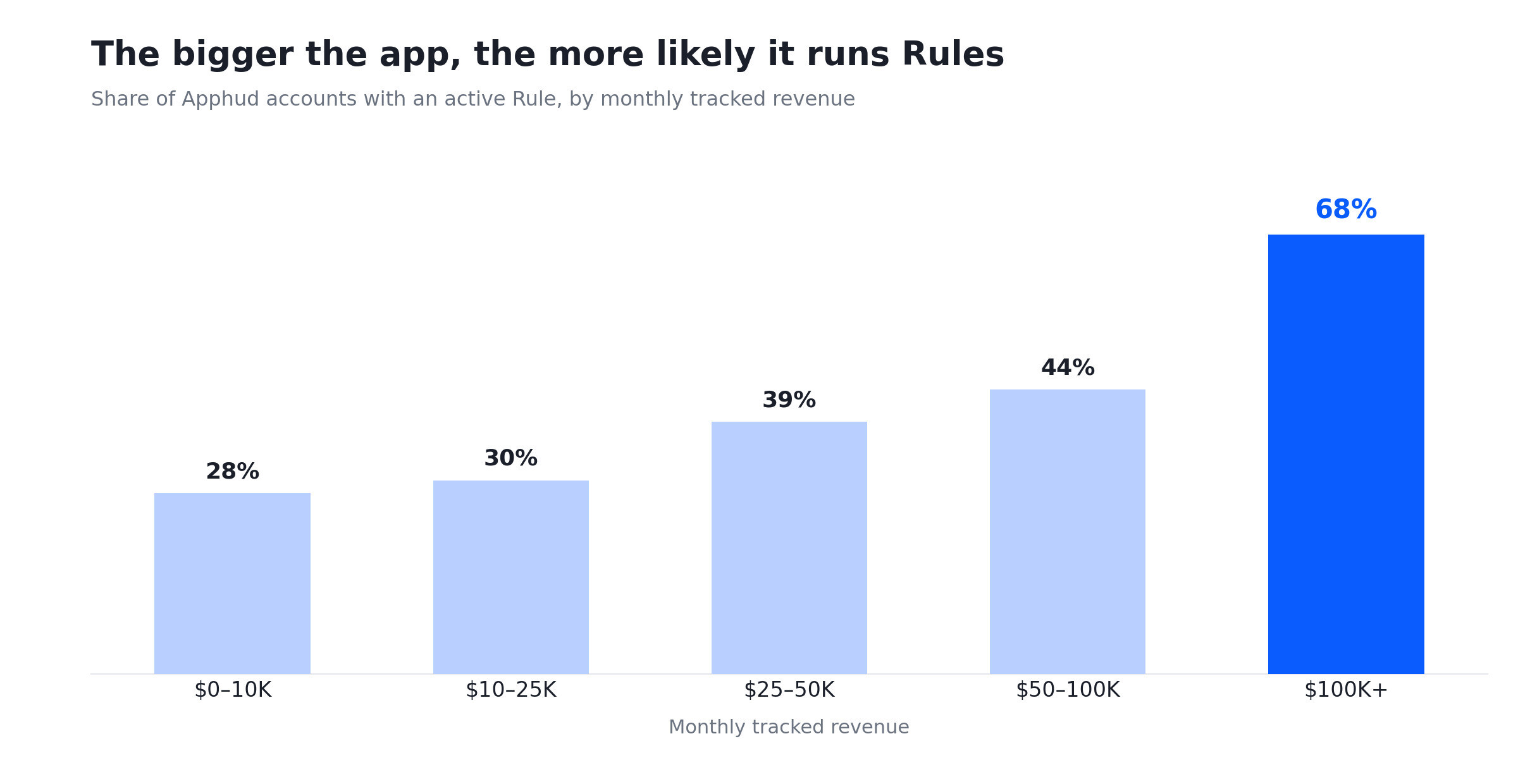 Rule adoption by app revenue at Apphud
Here's where teams put them to work, across the subscription lifecycle.
1. Recover revenue you're already losing
A failed renewal doesn't have to become churn. When a billing issue hits, a Rule can automatically reach the subscriber and walk them back to fix the payment — people who already intend to pay, just nudged to finish faster.
In production, subscribers who receive the billing-recovery push come back within 7 days at 14.0%, vs 11.8% for those the same rule tried to reach but couldn't — a +2.2 points (~19% relative) uplift. Most users recover on their own through store retries; the push is what wins back the extra slice on top. Today hundreds of apps run billing-recovery Rules in production.
But the sharpest lever is knowing when not to push. In our data, US subscribers recover just as well on their own as with a nudge — 15.8% without the push versus 15.2% with it. So the highest-ROI move isn't pushing harder — it's targeting the segments that respond and excluding the ones a reminder only annoys.
Zoom out, and geography shapes everything.
Looking at platform-wide user-to-paying conversion across all apps on Apphud — not Rules specifically — users in Iceland convert at 4.2%, Hong Kong at 3.7%, and Taiwan at 3.3%, while the US, the largest market by revenue, trails the leaders at 2.4%.
That spread is exactly why Rules let you build audiences by country: the offer, the timing, even whether to send a nudge at all can differ for each. Build the audience with the exception of the US, and the same Rule does more with every payment that fails.
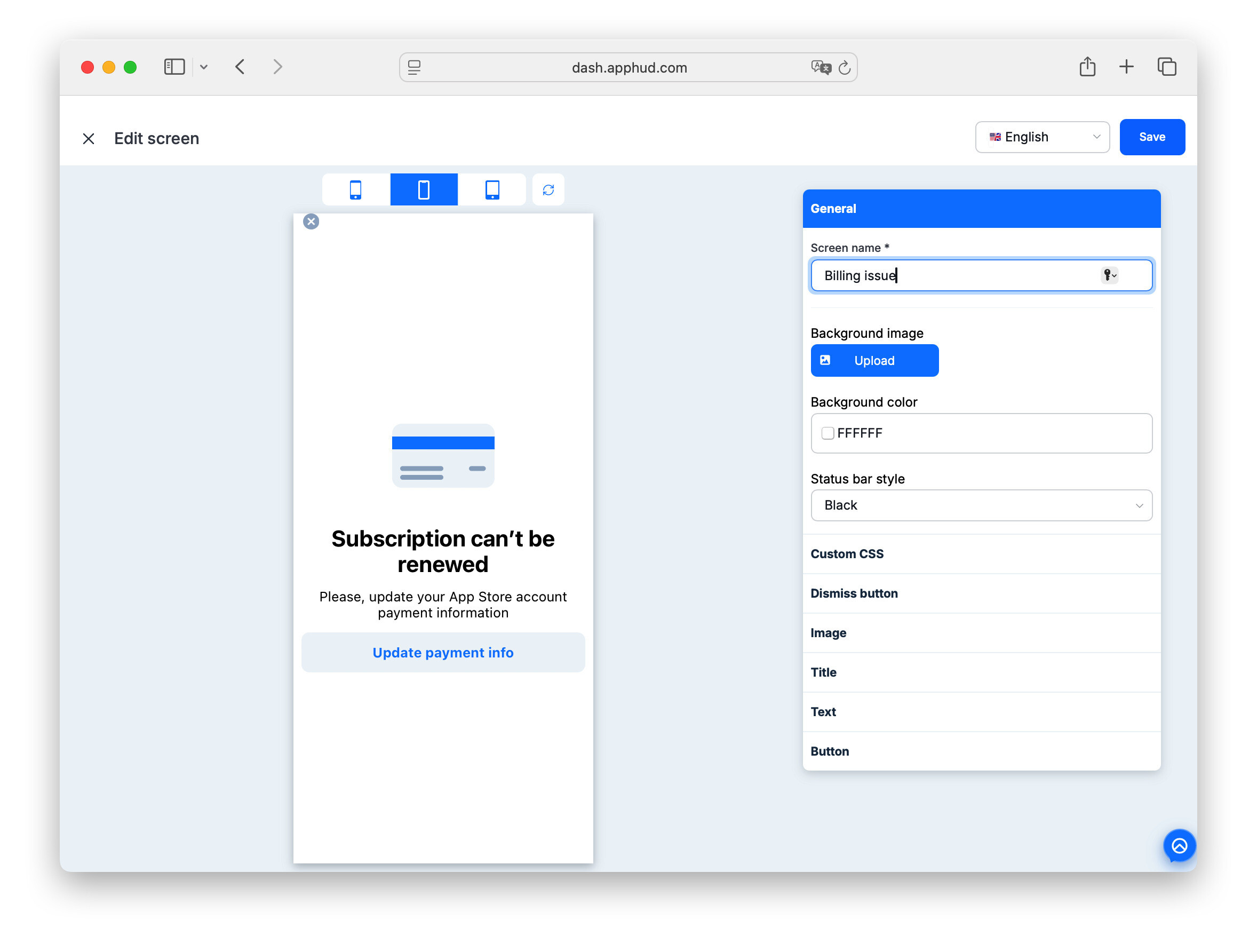 Payment fails → this screen fires. No code, no release — built at Apphud.
2. Catch the cancellation the second it happens
This is the Rule teams reach for first: 59% of all active Rule triggers fire on cancellation, and nearly 5,000 retention Rules are running in production today - more than any other use case.
A cancellation is a signal, not the end of the relationship. Trial cancelled fires when someone drops a free trial; Subscription cancelled fires when a paying subscriber turns off renewal. Two separate moments, two different messages: a survey to learn why, a win-back offer, or a reminder of what they're about to lose.
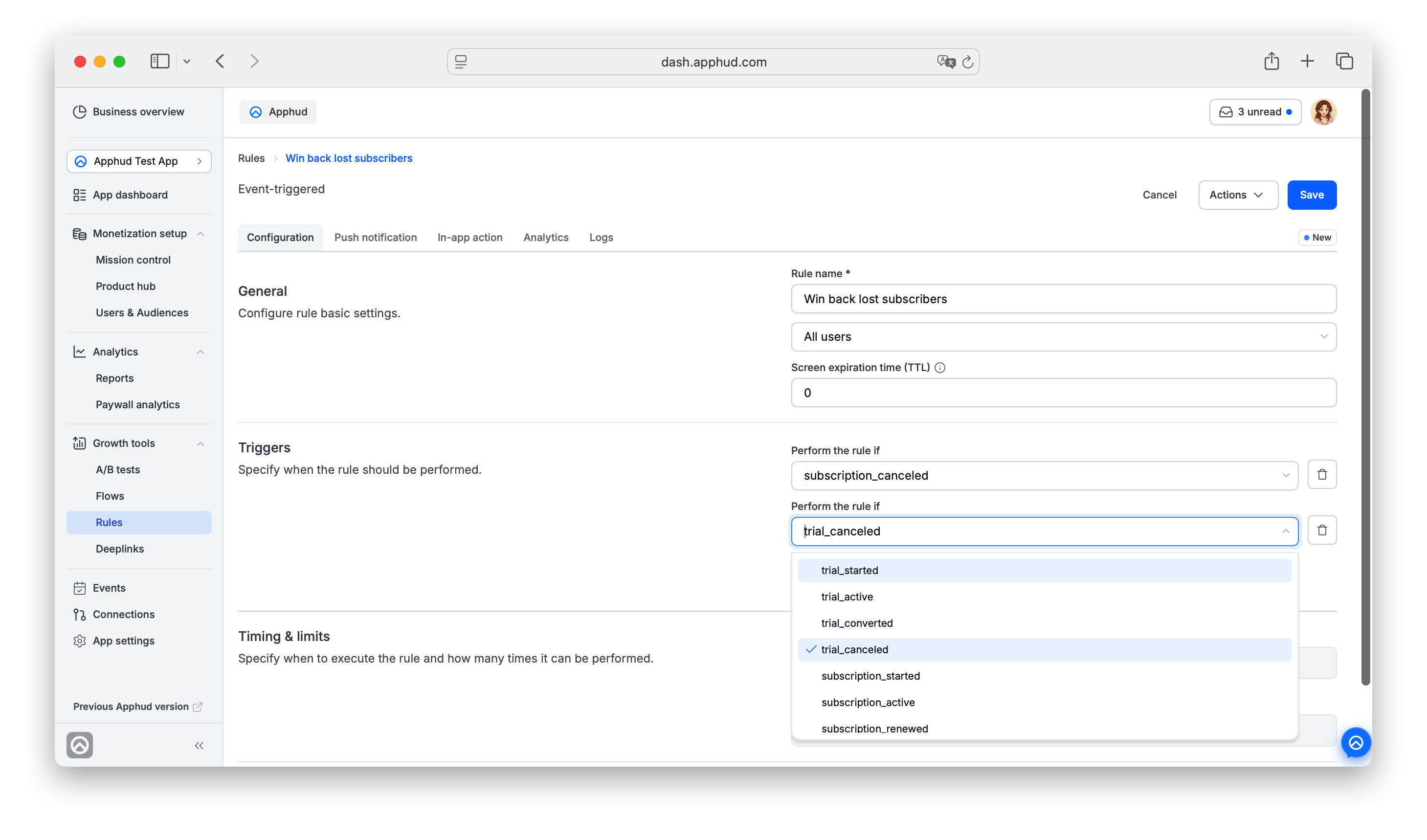 Subscriber cancels → this Rule fires. Pick the trigger at Apphud, no code.
3. Stop the refund before the money leaves
A refund request isn't a lost customer yet. It's a customer with a complaint — still in your app, still reachable, still holding the thing they paid for. Catch them there, before the refund clears and the relationship ends with it. A screen that asks what went wrong, or fixes the problem on the spot, turns a refund into a second chance.
4. Close the sale they already started
Someone tapped Subscribe, saw the payment sheet, and stopped. That's the highest-intent non-payer in your app, and the intent decays by the hour.
Trigger on Paywall checkout initiated, wait 30 minutes, and if they're still in your non-paying audience, show a promo offer while the decision is still warm.
5. Recoup your UA spend before day two
Every install has a price tag, and the window on it is short: roughly 90% of users who don't pay within their first day never pay at all. After that, the acquisition spend is gone.
Trigger on User created, wait 24 hours, and if they're still non-paying, send a push and open a promo screen. It's the last cheap shot at the biggest cohort you'll ever buy.
Each of these is one Rule: pick the trigger, set the delay, choose the audience, attach the screen. From then on it runs on its own.
6. Plan your next seasonal offer — no app release
Black Friday is a couple of months out, and your promotion doesn't need to wait for a build. Schedule a Rule for a specific date or a recurring window, and Apphud shows your offer as an in-app screen at exactly the right time — launch it and stop it remotely, no release cycle.
Scheduled Rules with pushes and screens do the work. Some apps earn over $40K each this way. Use it for Black Friday, Cyber Monday, holiday promos, or any limited-time offer.
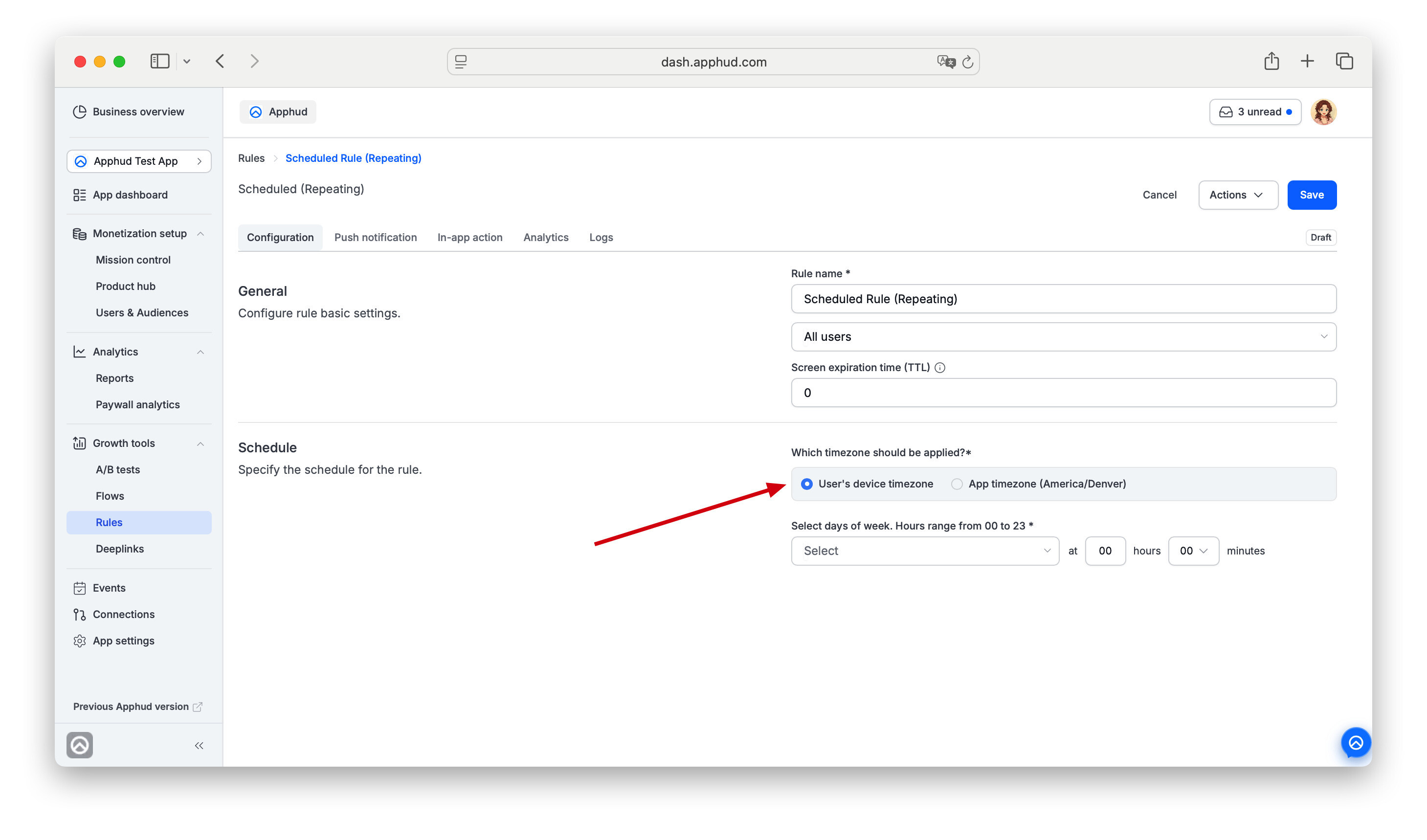 Scheduled Rule at Apphud: pick the day and hour — it fires in each user's own timezone.
Set it up once. It keeps recovering revenue.
A Rule you build today is still working next year. In production, active Rules run for a median of 19 months - and teams that lean on them run dozens per account, one for each moment worth catching.
They reach people two ways, push and in-app screens, so "notifications off" doesn't mean unreachable. And if you already run OneSignal or Pushwoosh, keep them. Most teams run Rules alongside those tools, not instead of them.
You don't need all six. Start with the leak costing you the most — for most teams that's the failed renewals — and build one Rule this afternoon.
Go to Apphud to create your first Rule →
